Posts

Showing posts with the label science world

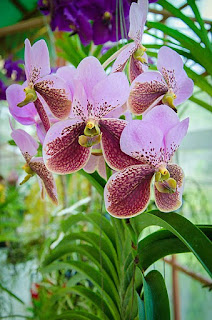
Waling-waling : "The Queen of Philippine flowers"

Image
Waling-waling Image courtesy: I Travel Philippines / Wikimedia commons ( CC BY 2.0 ) Waling-waling ( Vanda sanderiana) is known as "The Queen of Philippine flowers". It is a beautiful flower in orchidaceae family, commonly known as Waling-waling or Sander's Vanda. This species was described by Heinrich Gustav Reichenbach in 1882.

How to tell the age of a tree

Image
Annual rings (Image courtesy: Amanda Tromley)                If we examine the trunk of a tree that has been chopped down, we will see first of all the outer ring of the bark which acts as a sort of waterproof coat for the tree. Inside the outer covering come a number of concentric rings.                  Each one of these rings represents a year in the life of the tree. The space between the rings is the wood which the tree produced during one year.                 By counting the number of rings we can tell when the tree was born. These rings also indicate the dry periods the tree lived through as well as wet periods. In dry times the rings are very thin. In heavy rain fall years the rings are thicker. Image courtesy: Christian Schnettelker               Slender course of wood can be t...

How to prepare a bird table

Image
Image courtesy: GT1976 / wikimedia commons            If you like birds and do not like to see them shut up in cages, you can still have the pleasure of watching them live in their natural state by setting up a bird-table for them. Bird tables are a wonderful way to feed the birds.        To make a bird-table you need a long pole which is driven into the ground near a tree or shrubbery. Next you get a small box with low sides and nail it to the top of the pole to form a flat, horizontal surface for the birds to land and perch on. Some barbed wire wound round the bottom of the pole will stop cats from climbing up to the table. Image courtesy:  Karelj / wikimedia commons          What sort of food should be put on a bird-table? Breadcrumbs are not enough. There are two menus, one for birds that eat seeds and another for birds that eat insects. For the seed-eaters you need millet, barley, rice ...

How cedar oil is made

Image
                Cedar oil is an essential oil which the ancient peoples used to embalm dead bodies. It was also once used to coat books to preserve them from insects and damp. It has a pleasing scent.                   The oil is produced by distilling it from the African cedar and is an essential oil, that is one that gives a plant, flower or fruit its distinctive odour or flavour. These oils are used for the scenting or flavouring of numerous products, such as perfumes, cosmetics and soaps. cedar of lebanon   (Image courtesy: Yhabbouche / wikimedia commons)                     The African cedar grows in the north of that continent, especially on the Atlas Mountains. It is a very imposing conifer that bears many leaves and grows to a height of more than 40 meters. It closely resembles the more famous cedar of Lebanon which wa...

How the poison of jimson weed acts

Image
Datura stramonium    (Image courtesy: TeunSpaans / wikimedia commons )             Stramonium, or the jimson weed is also known as 'the devil's grass'. The plant got this name because its poison seems to drive the victim made as if he were possessed by the devil.           The tropane alkaloids in the plant can also cause serious distortion of the eyesight. Ingestion of jimson weed induces delirium, blurred vision, drying of mouth, tachycardia, hyperthermia, mydriasis, and amnesia. Symptoms of jimson weed intoxication may last 24 to 48 hours. In small doses, however, these poisons can be used to treat certain illnesses.           Stramonium found in certain drugs is extracted from the leaves of this plant. It acts as a sedative and eases nerve and rheumatic pains. Stramonium leaves are also used to make special cigarettes for the treatment of asthma. The seeds of the plant provide an o...

How the female hornbill is imprisoned while she hatches the eggs

Image
                Hornbill   (Image courtesy: wikimedia commons )                    Like the toucan, the hornbill has an extremely large beak. The beak is different because it continues above the bird's head to form a sort of knob that looks like a helmet. There are forty five different species of hornbills, with loud, croaking voices and flapping wings. Their strong beaks can break the shells of the hardest nuts, but they will also eat fruits, insects and small animals.                   Most hornbills build their nests in a hollow tree. The male bird imprisons the female inside her nest by walling her in with dried mud while she hatches the eggs and cares for the young until they can fly. He leaves a small slit in the mud wa...

How fish can live in the desert

Image
Sahara desert  (Image courtesy: fr:Utilisateur:Jgremillot / wikimedia commons )                 Although it is difficult to believe, there are fish living in the desert. Several important expeditions have gone to the Sahara to uncover the mystery of these fish which are sometimes found scores of meters down.                The most famous is the lungfish which lives in the larger African rivers. When these rivers overflow their waters can spread out to desert regions to form small lakes or ponds. When the lake dries up the lungfish buries itself in wet mud where it can live for months on end, especially if it goes deep enough to find an underground layer of water.               Lungfish are among the most ancient bony fishes and are very like those which lived 20...

Tulsi (Ocimum sanctum)

Image
Synonyms : Sacred Basil, Holi Basil. Family : Labiatae Ocimum sanctum  (Image courtesy: Jubinrajop /  wikimedia commons ) Geographical occurrence : It is considered to be a sacred plant by Hindus. It is cultivated throughout India in gardens of temples and houses and is worshipped as the avatar of Lakshmi.   Characters :  The plant is an annual herb of 30 to 60 cm in height. The branches are generally purplish, sub-quadrangular and covered with soft hairs.The plant bears petiolate leaves having an entire or serrate margin. The apex and base are acute. The leaves are minutely gland-dotted and contain trichomes on both the surfaces. Flowers are verticillate, in recemes, 15-20 cm long in close whorls. Odour is aromatic and taste is pungent. Nutlets are subglobose, slightly compressed, pale brown or red in colour. Seeds are reddish-black and subglobose. Constituents : The major constituent is a volatile oil (0.7%) which contains eugenol, meth...

How bees produce wax and honey

Image
(Image courtesy: wikimedia commons)               The wax produced by worker bees is used in making honeycombs consisting of six-sided cells into each of which the queen bee lays an egg that will eventually give birth to an insect. Other cells in the honey comb act as a storage places for honey.               Bees produce wax in very thin sheets from eight glands on their abdomens. It takes some 1,250 of these sheets to make up one gram of wax. We can imagine the amount of hard work that goes into the construction of a honey comb. Not only does the bee produce the wax, but it also shapes it into the hexagonal cell.               Chemically, beeswax consists mainly of esters of fatty acids and various long-chain alcohols. It is used as a glazing agent, a sweetener, or in the production of cosmetics and pharmaceutical...